Prepare the welding setup
Confirm robot-to-Fronius readiness, select a named welding job, and apply the correct tool center point and load profile.



SPARTAN WELDX PROGRAMMING
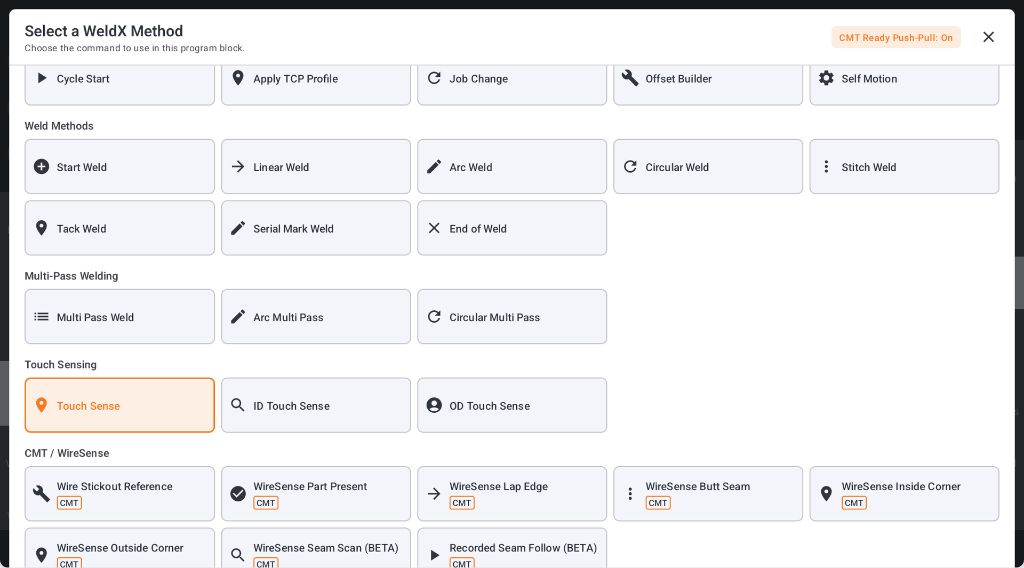
Spartan WeldX gives welders one guided pendant workflow to teach paths, select Fronius jobs, apply welding behavior, sense the real part, and save work for the next production run.
FROM A NEW PART TO A REUSABLE JOB
Confirm robot-to-Fronius readiness, select a named welding job, and apply the correct tool center point and load profile.
Move the torch to the required locations and capture poses directly inside the supported welding command.
Build linear, arc, circular, stitch, tack, or weave operations without assembling the path from disconnected low-level commands.
Use Touch Sense, WireSense, offsets, and job changes when the part or process requires additional correction.
Review motion, edit values, reteach poses, and keep the welding settings attached to the operation being changed.
Store the job so repeat work can be selected, checked, adjusted, and returned to production on a future run.
ONE PENDANT WORKFLOW
WeldX keeps the information an operator needs close to the welding operation: named Fronius jobs, live readiness, taught poses, process settings, motion previews, sensing routines, and support tools.
The result is a workflow designed for the people who understand the part and the weld. Training and application development are still important, especially for complex geometry, sensing, coordinated motion, and engineered fixtures.
WHAT EASY SHOULD MEAN
Programming time depends on weld geometry, fixturing, sensing, process requirements, and operator experience. Spartan application review is built around the real test: move from a representative part to the first acceptable weld, then change jobs and return to the original program.
TRAINING AND SUPPORT
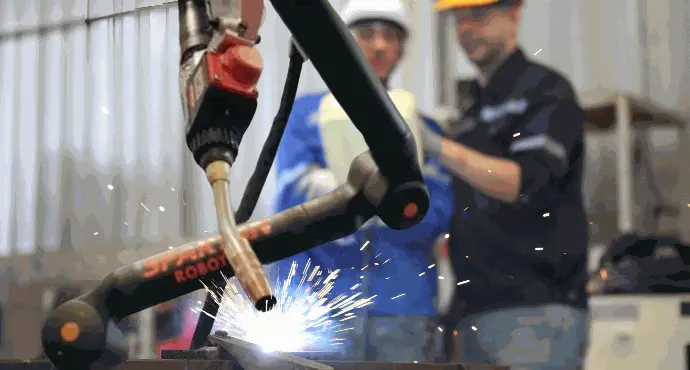
Spartan supports operators during startup and provides ongoing virtual assistance for the life of the system.
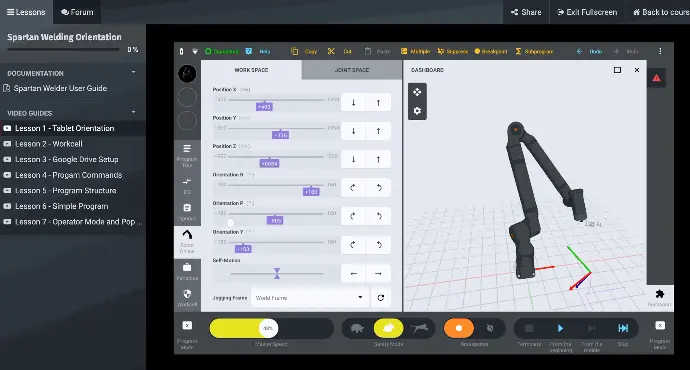
Operators can return to structured training material as jobs, people, and production requirements change.
PROGRAMMING QUESTIONS
WeldX is organized around guided welding commands and taught poses rather than expecting the operator to build every weld from low-level robot instructions. Operators still receive training, and complex applications may require additional application support.
It depends on the part, fixturing, number of welds, sensing, and process requirements. The most useful evaluation is a timed demonstration using a representative customer part rather than a generic demo coupon.
WeldX organizes robot-to-Fronius status, readable job names, welding commands, process selection, and live feedback inside the pendant workflow while the Fronius power source provides the welding process technology.